
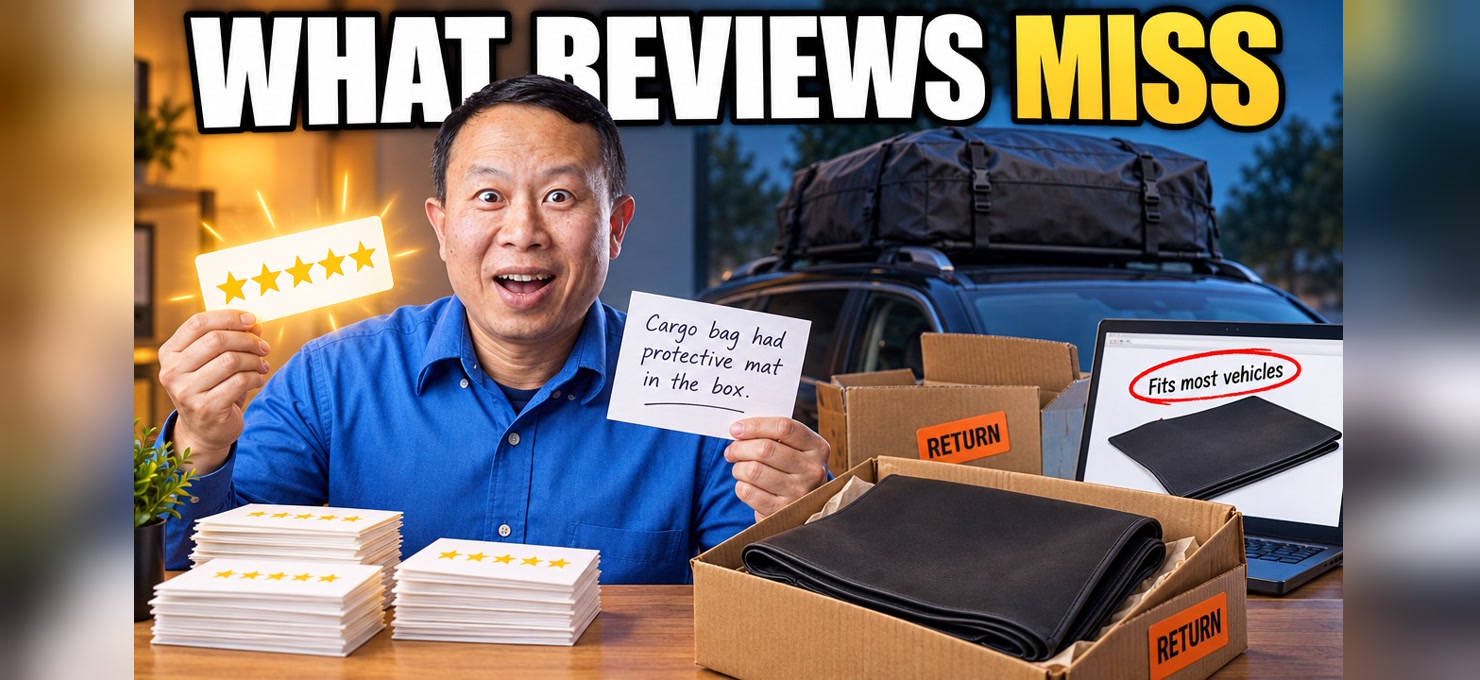
I had just found out why my most-returned product kept coming back.
It’s a mat you lay on your car roof, under a cargo bag, so the bag doesn’t scratch the paint. Across 2024 and 2025, customers sent back 18% of the ones we sold. The rest of my Amazon store runs about 4%. My AI had read all 494 return comments, and about one in five said the same thing: the cargo bag they bought already came with a mat. They had bought a second one they didn’t need.
That was the answer. What bothered me was how long it took. Those returns had been piling up for two years, and I had never seen the pattern.
Every listing audit I’ve ever done starts in the same place: the reviews, worst first. So I went back to see what they would have told me.
They had plenty to say. The mat slid backward on a long drive. It left a residue one customer had to have professionally removed. It was too small: “Product will not even cover a quarter of your suv roof.” It was too thin: “Thickness should be part of the product description but instead one has to rely on the pictures.” One three-star reviewer even gave the advice I would have given: “I should pay more attention to the 1-3 star reviews.”
Read the reviews, and the job looks obvious. Make it bigger. Make it thicker. Make it grip. A product problem.
Then I searched them for the thing behind one in five return comments.
Nothing.
Not one reviewer complained about buying a mat their bag already included.
The only review that mentions it at all has five stars. A happy customer: “It’s thicker than the one that came with the bag.”
The reviews knew cargo bags come with mats. They just never said it was a problem.
Reviews hear from the customers who kept it
Reviews and return comments aren’t two views of the same customers. They are two different groups of people.
A reviewer kept the product, used it, and chose to write about it. A customer who realizes their bag already has a mat sends the second one back. They had no use for it, so they have nothing to review. Their whole experience was the listing and the return.
So reviews are good at one thing: how the product performs once it’s in use. Did it slide. Did it scratch. Did it fit. Return comments catch something else: the gap between what the listing led someone to expect and what showed up at the door.
An audit built on reviews alone only listens to the customers who stayed.
Three sources, three different witnesses
- The listing is what you promised.
- Reviews come from the customers who kept it.
- Return comments come from the customers who didn’t.
Put them side by side and the complaints sort themselves.
Both groups say it: fix the listing first. Size and thickness show up in reviews and in return comments. A reviewer: “Thickness should be part of the product description.” A returner: “The product description says it is universal but it’s not, it confused me.” Another: “Had current similar one. Thought this was thicker.” Two groups of customers who never talked to each other, pointing at the same lines. When I checked the listing on October 3, 2026, the title promised “EXTRA PADDING” and a “UNIVERSAL ROOF RACK PAD”, a bullet said the size “fits most vehicles”, and the copy called it a “thick protective pad” without ever saying how thick. When both sources agree, that is the most reliable fix you will find.
Only the returners say it: the problem is before the purchase. The duplicate mat lives entirely in return comments. It’s a listing problem too, but a missing line rather than a wrong one: nothing told shoppers to check whether their bag already came with a mat. Reviews will never surface this kind of problem, because the people who have it don’t keep the product.
Only the reviewers say it: the problem is in use. Sliding, residue, a scuffed roof. These came from people who put the mat on a car, and they barely appear in the return comments. That’s a product and instructions question, not a listing question.
Each bucket has a different owner: the listing copy, the product spec, the instructions. Read one source, and you fix one of them and think you’re done.
How to run it on your own listing
Three inputs, one question.
- Copy your listing page. Title, bullets, description. Paste it into the AI. This is what you promised, and it’s the one part you supply by hand.
- Pull the reviews and the return comments for the same product. With the Seller Labs MCP Server, both sit in the same place, matched by ASIN, so the AI pulls them itself. No exports, no spreadsheets.
- Ask one question. “Here’s what my listing promises. Compare it to what reviewers and returners say. Where does the listing cause the complaint?”
Then have it sort every complaint into the three buckets: both sources, returns only, reviews only. The first bucket is your rewrite list. The second is what your listing is missing. The third goes to whoever owns the product.
One more instruction worth giving: quote the customer, don’t summarize. “Universal but it’s not” is a line you can act on. “Some customers had sizing concerns” isn’t.
Six more questions for the same data
The three buckets find what’s broken. The same reviews and comments answer more than that. Each of these is one more question, and each one found something on the mat.
1. What do customers call it? Ask for the words customers use for the product and the things it goes with, and compare them to your title. My return comments said “carrier” and “cargo bag” over and over. My title led with “protective mat” and “roof rack pad.” The words customers use are often the words shoppers search with.
2. What does the listing say it works with, and who came back because it didn’t? Ask the AI to list every compatibility claim on your listing, then find the returns that contradict each one. My listing said the mat works with roof rack crossbars, roof baskets, roof boxes, bike racks, kayak racks and trunks. The return comments answered: “Doesn’t fit my roof rack.” “No car roof rack, no need.” “Bought 2 to line my trunk but it doesn’t fit as I expected.” Every use you claim is a promise someone will test. Say exactly where the product goes instead.
3. What already comes in the box of the things it’s bought with? The duplicate problem went beyond cargo bags. “Found my roof rack came with one.” “Didn’t know this came with the roof box I bought.” If you sell an accessory, ask which of the main products already include it, and put that on your listing before a shopper finds out at the door.
4. What do happy customers say worked? Read the five-star reviews for proof, not praise. “Carried 3000 miles across the country. Roof was not scratched.” Another drove over 1,000 miles, some of it in rain: “No slippage, no scratches.” That is a stronger opening than the bullet my listing ended on: “ADD this car roof mat to your cart and buy now!” One five-star review did even more. “It’s thicker than the one that came with the bag” turns the duplicate problem into the pitch: this is the upgrade for the thin mat that came in the box.
5. Is the complaint big, or just loud? Check a complaint’s size before you fix it. Amazon’s “Customers say” summary, at the top of the reviews, is generated from the text of the product’s reviews and tags each topic with a count. When I checked it in October 2026, grip was the mat’s most-mentioned topic, and the summary called the mat effective at keeping bags in place. A few return comments and one review said it slid. Writing “grip” out of the listing would have fixed a minority complaint and buried the thing buyers mention most. The same summary said customers “disagree on the size” and “similarly disagree on the thickness.” That one is real.
6. What would a shopper ask before buying? AI shopping assistants, Amazon’s Rufus among them, answer shoppers from your listing and your reviews. Ask the AI to write the questions a shopper would ask before buying, then check whether your listing answers each one. For the mat: How thick is it? Will it cover an SUV roof? Do I need it if my bag comes with one? Do I need a roof rack? My listing answered none of them. Any question your listing doesn’t answer gets answered by a review, or by a return.
What the mat’s listing needs
Put it together and the fix list for one product writes itself:
- State the thickness as a number, not “thick”.
- Show the mat on an SUV roof, under a bag, so shoppers can see what it covers.
- Replace “fits most vehicles” with what it actually covers.
- Add one line: check whether your bag, box or rack already includes a mat.
- Say where it goes, flat on the roof under a soft cargo bag, and cut the list of every carrier type.
- Position it as the thicker upgrade to the mat that comes with many bags.
- Lead with proof in customers’ words: long trips, no scratches.
- Keep “grip”. It’s what buyers mention most.
Every item on that list needed at least two of the three sources.
The customers who stayed
I used to think reviews were the voice of the customer. They’re the voice of the customers who stayed.
The ones who could have told me what was wrong with my listing never stayed long enough to write one.