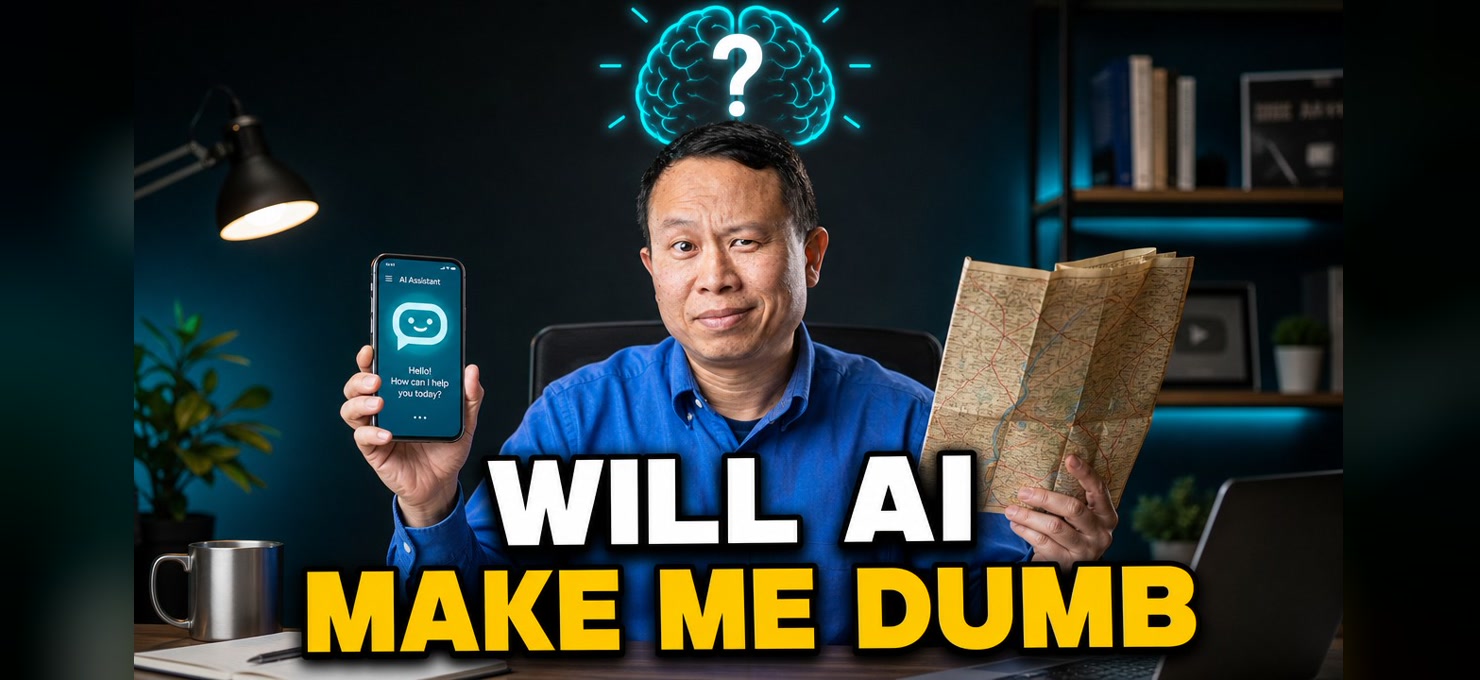
Question 14 of 16 is on the screen. The team sent me their questions before this AI lunch-and-learn, for a product company with a few dozen people, and this one is the quiet fear sitting under all the others. If AI does the day-to-day work, how do we keep from getting dumb?
So I ask the room how many of them could read a map and get from this office to downtown Atlanta.
The hands go up.
“Good,” I say.
They have the skill.
“My kids can’t,” I tell them. “They use Google Maps.”
For a second, that sounds like the answer to question 14. A skill handed to a machine, gone in one generation. If that happened to map reading, it can happen to anything this room does for a living.
But nobody in my house is dumber for it. The app took the turn-by-turn, and the thinking moved up a level: where should we go, and what should we do when we get there.
The other path is always open. Anyone can let the app do the driving and spend the saved hour on Netflix. That is a choice a person makes. The app didn’t make it for them.
The skill did not disappear. It changed shape.
Same trumpet, different skills
James Stovall of Workfast Consulting has a better picture for this, and I borrowed it for that room.
In a marching band, everyone has the sheet music. Every step is counted. Excellence means precision: the right note, on the right step.
In a jazz band, nobody knows exactly what comes next. Excellence means listening to what the others just played, and answering it.
Same trumpet. Same player. Different skills.
A lot of office work is marching band. Export the report, paste it in, refresh, cross-check the tabs. AI is very good at marching. What it hands back is jazz: an answer nobody on the team wrote, that somebody has to listen to. Whether that spike is real or just one big order. Whether to trust a vendor’s date. That is the part of the job that is left, and it was always the valuable part.
Here is the piece of the picture people miss. Jazz players are not less trained than marching players. They spent years on scales before anyone let them improvise. Nobody riffs on notes they don’t know.
Keep your scales
So the answer to question 14 is not to avoid the tool. It is to keep your scales.
Never accept an answer you couldn’t have gotten to yourself eventually. You don’t have to do the work by hand. You have to be able to. If the AI gives you a number and you have no idea how it got there, you are not playing jazz. You are just holding the trumpet.
Use it like a calculator. You still know roughly what the answer should be, and you notice when it is off by a zero. The machine does the arithmetic. You keep the judgment.
Do it badly first. I like to say that anything worth doing is worth doing badly, because you have to do it badly before you learn it. The line is G.K. Chesterton’s, from 1910, and he meant something close to this: some things you have to do yourself, however badly. Do the analysis yourself a few times, badly, until you know what a good one sounds like. Then hand the sheet music to the machine.
My kids may never fold a paper map. That’s fine. What matters is that they still know where they are going.
AI can play every note on the page. Make sure you still know the scales.